Why I put this issue together
All four landed on arXiv on 27 October. All four deal with how a generator fits into a working pipeline.
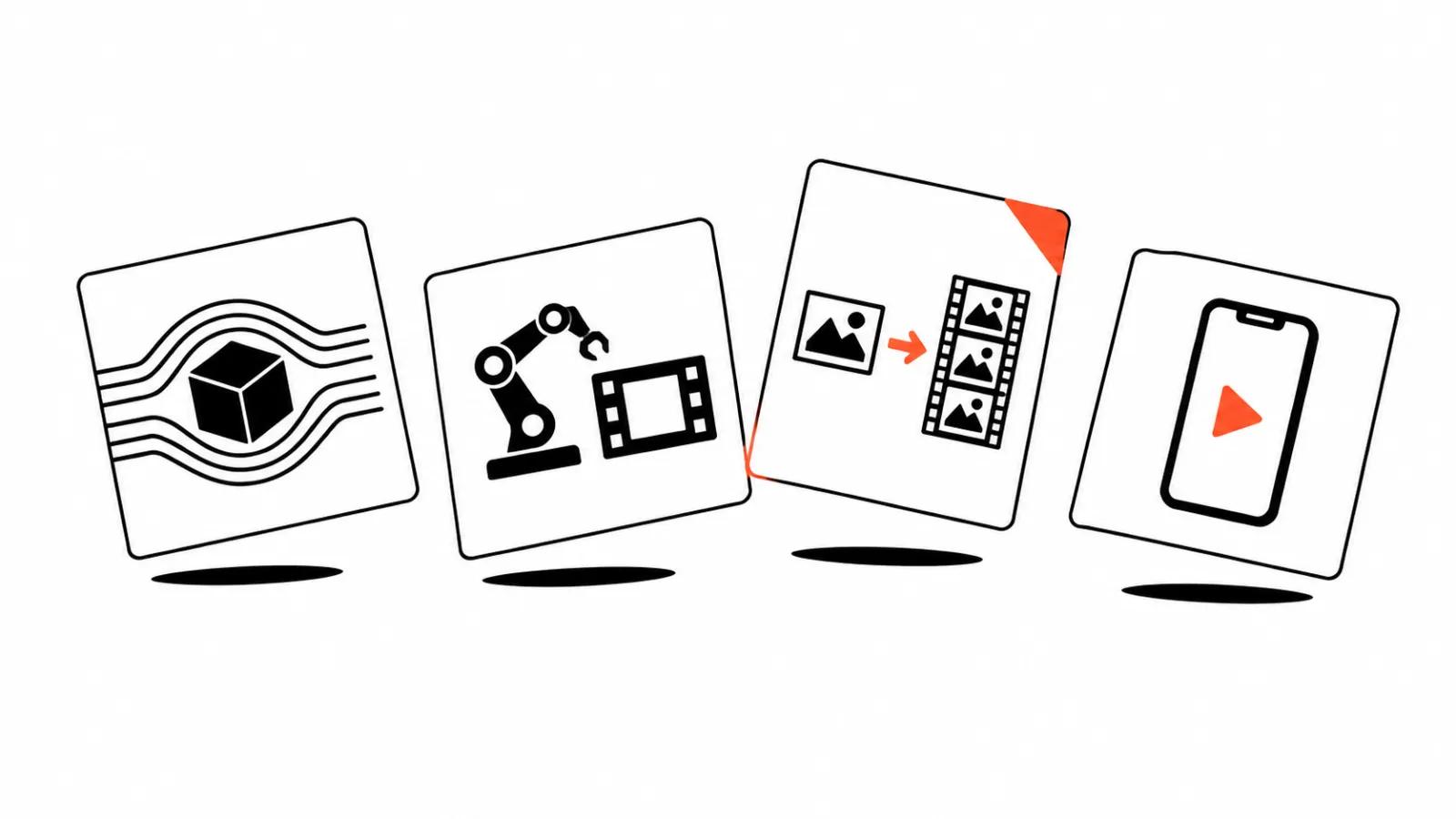
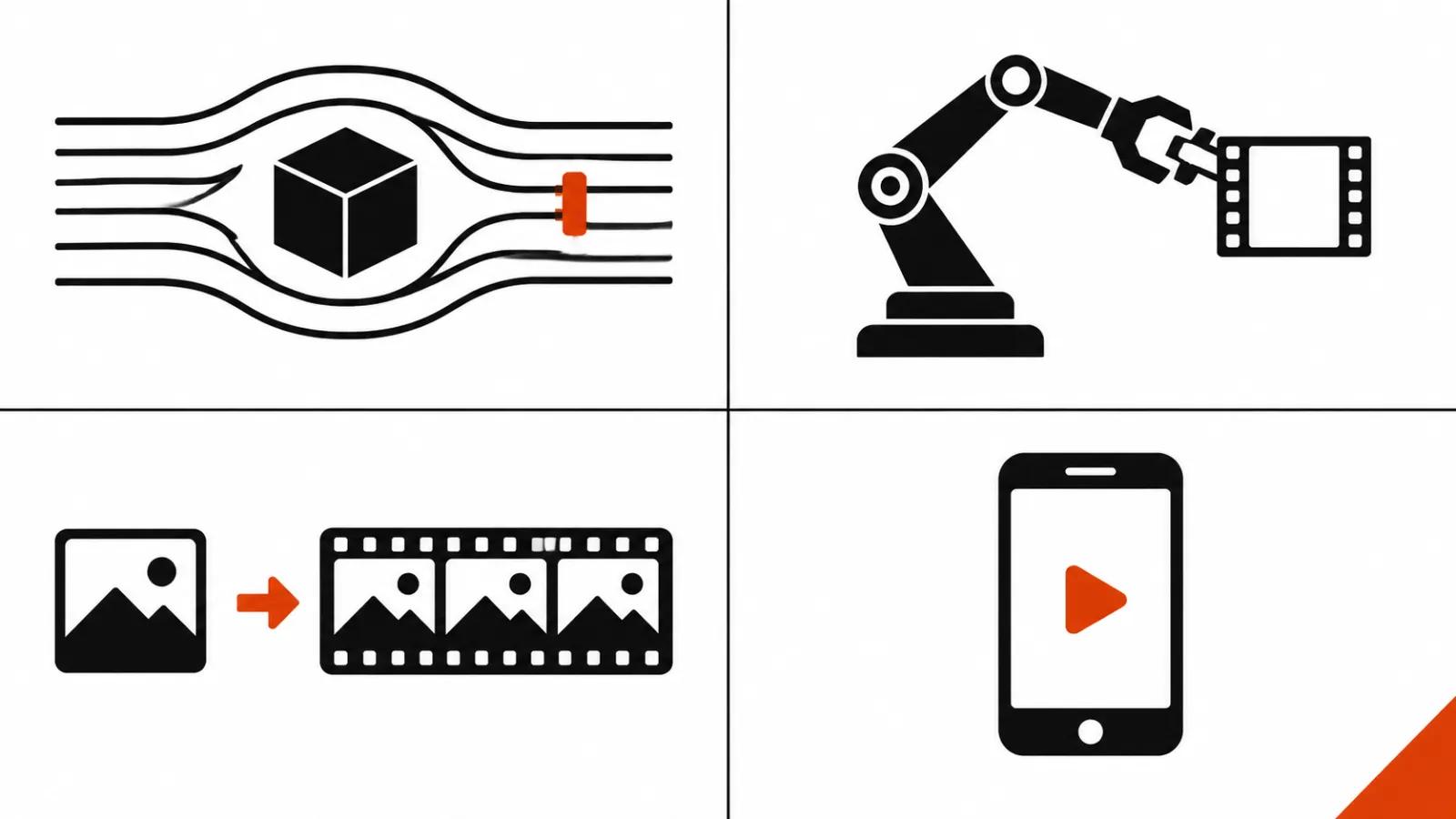
One removes a reshoot when a new object enters a scene. One turns a video model into a controller for a robot. One makes a video model draw still images. One measures what any of this can do on a phone.
Under each item I write why it matters. Without that, reading preprints turns into collecting links.
1. ReferStream: a new subject without a reshoot
arXiv:2610.37566 tackles something that often appears in demos and rarely reaches a working pipeline. A new object, person or product has to enter streaming video while the established scene survives.
The authors propose a method that needs no extra training. The reference is placed into target regions of the latest scene latent, so its features are extracted in context. The injection chunk is then conditioned on those features, and the overwritten global cache entries are restored.
In plain terms: the model does not repaint the past. It inserts the new subject and keeps the memory of the old one.
To test it, the authors built ReferStream Bench, with scheduled reference arrivals, evolving instructions and explicit annotations of subject presence. The method beats baselines on text adherence, subject similarity and count accuracy.
Why it matters: in advertising the product changes later than anyone plans. Adding it to a finished shot without rebuilding the whole scene saves time and money.
2. TAPESTRY: one model for video and a robot
The second paper, arXiv:2610.36823, takes a pretrained video diffusion transformer and turns it into a robot controller. No video comes out at inference.
The trick is to treat a robot action as a single patch in the latent space of the video model. A linear projection maps each action timestep to patch dimensions, and the same transformer backbone processes it.
Training uses three diffusion objectives: video diffusion, joint video and action diffusion, and action-only diffusion. At test time the model produces an action chunk in a single DDIM step from noise.
The authors report 84 milliseconds per action chunk on consumer hardware, and they avoid the cost of full video generation.
Why it matters: the physics a video model learns from footage turns out to be useful outside video. The same idea could one day check whether a scene moves plausibly before anyone renders it.
3. FrameForge: a video model that draws stills
The third paper, arXiv:2610.36545, uses priors from video models for image generation and editing. The task is old: one image sets the condition, text sets the target.
Most approaches place condition and result at fixed temporal positions. The authors observe that the relationship varies across tasks and introduce virtual temporal relations that the model picks per input.
Two mechanisms carry it: a mixture of temporal experts sets the distance to the target, and a chain of temporal reasoning describes a latent intermediate state with a reasoning-bottleneck mask.
On DreamBench, COCO2017 and GEdit-Bench the method scores best in subject-driven generation, canny-to-image generation and editing among compared approaches.
Why it matters: the wall between video and stills is coming down at the architecture level. A team no longer needs two stacks for a frame and for a static ad.
4. MoI-Bench: generation on a phone
The fourth paper, arXiv:2610.37599, is a benchmark for image generation and editing on mobile devices. It holds 64 subtasks and 1,150 samples.
Tasks sit on two axes: 16 operations such as removal and replacement, and eight visual target categories including portraits and text. Their intersection defines a task, for example removing facial makeup.
The MoI-Eval layer scores instruction following, visual quality and detail preservation, then maps results into quality and deployability profiles.
The authors note that a narrow gap such as text replacement deserves priority over a broad goal like improving text editing in general.
Why it matters: some edits for short-form video at scale are easiest to make right on a phone. The benchmark shows which operations can run on device and which need a server.
What the four have in common
All four are about integration. The model stops being a black box that returns a clip for a prompt and becomes a part of a system: with scene memory, with controllable actions, with shared priors for video and images.
The second common thread is evaluation. Each paper brings its own test set, because public leaderboards do not answer whether a model fits one job.
The third is compute. One step at inference, insertion into an existing scene, a mobile loop next to a server loop.
What a business does with this
Start with the supplier question. Ask how a model behaves when an object is added to a finished scene. That is closer to real work than a demo built from nothing.
Then look at the cost of an iteration. If every fix forces a full re-render, you pay for each version and testing becomes a luxury.
Then check where the frame is computed. For social placements some operations move to the device, and that changes a team's budget.
AI video production already covers backgrounds and secondary shots. These papers suggest the next step is controlled edits inside a shot, while handcrafted videos stay where a real person and their delivery are the point.
The conclusion
None of the four promises a product. All four point the same way: generation becomes steerable, cheap to iterate, and shared between video and stills.
Read them for the questions they raise about your process. What does one fix cost, what happens to the scene when a subject is swapped, and where is the frame computed.