Start the month without a camera
A month does not start with a shot list. It starts with three questions that need answers before anyone books a day.
What should happen to the person who watches the clip: do they write, call, walk in, remember the name.
How many times a month that action has to repeat before it registers.
What the business already owns: people, premises, product, expertise, existing photos and footage.
The answers set the volume. If there is one task and it happens once, a month is unnecessary and you need one clip. If the task repeats, you get a stream, and the stream has to be capped in advance.
How many clips you actually need
The rule I use: count scenes and hours, the clips arrive on their own.
Take the calendar and cross out the days when shooting is physically impossible: production downtime, holidays, warehouse load. What remains is the real window.
Then estimate how many scenes fit into one production day. For one person with a camera and a light, that is usually ten to fifteen short scenes, provided the script exists and nothing needs rebuilding between setups.
Only then convert scenes into clips. A thirty-second clip is three or four scenes. A three-minute clip is ten to twelve.
That takes the number from thirty down to eight or ten, and the plan becomes doable.
Where AI helps in planning
A model is good at three things.
Laying out topics. Feed it a list of customer questions, get a list of topics mapped to formats.
Draft scripts. A structural draft: what opens, what the middle argues, how it ends. Final copy is better kept away from the model.
Repackaging. One shoot becomes several versions: a short vertical, a mid-length cut, a page version.
It is bad at everything else. The model does not know your production, cannot see that Wednesday is fully staffed elsewhere, and cheerfully invents formats nobody can shoot. A plan written entirely by a model is usually elegant and impossible.
A four-week template
The template that holds up without heroics.
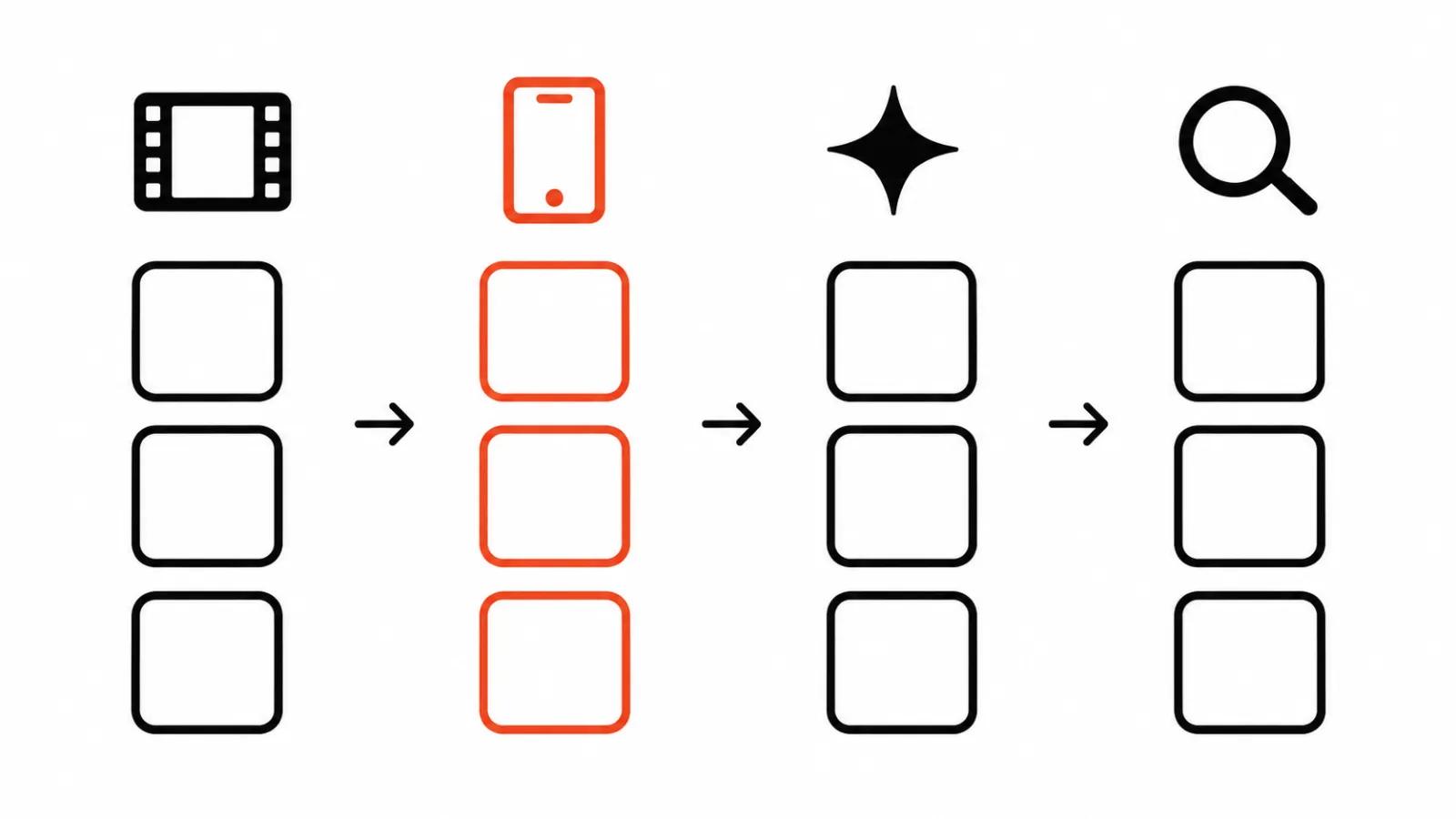
Week one: one long clip. Shoot, edit, publish. It lives for a long time and works for search.
Week two: a series of short verticals from the same footage. Cut down, reassembled, captioned. This is where AI earns its place, since the source already exists.
Week three: clips without a shoot. Generated frames, product motion, simple inserts. This is the buffer for a shoot that slipped.
Week four: the review. Look at what worked and move the winning formats into next month.
The grid does not need thirty ideas. It needs one production day and one generation session.
Shoot or generate
The logic is simple. A camera is needed where a real person, a real room or a physical product appears. Generation wins where you need a backdrop, motion, seasonal graphics, or a frame that is expensive to shoot.
About vertical specifically. When the goal is reach, the feed carries the volume and the site stays a shop window. It pays to know how vertical videos for business are built, because the first seconds and the rhythm obey different rules there.
| Format | Method | Per month |
|---|---|---|
| Customer problem story, 1-3 min | shoot | 1 |
| Verticals cut from footage, up to 3 min | edit existing | 6-10 |
| Product in motion | generate | per launch |
| Walkthrough or teardown | screen and hands | 1-2 |
| Seasonal intro, backdrop, transition | generate | 2-3 |
| Testimonial or expert comment | shoot | 1 |
The production day
Plan the shoot as a shift with a scene list. Improvisation on set is expensive.
Light and backdrop first. One position, one set of backdrops, no rebuilding between scenes.
Then scenes in order, simple to hard. The simple ones buy a buffer if the day slips.
Then takes. Three per scene at most, otherwise perfectionism eats the day.
Last, check the footage on location: watch one take on a phone so focus problems do not surface in the edit.
What open price lists actually say
Numbers you can verify. The official Pika pricing page states that a five-second Seedance 2.5 clip at 720p costs 122 credits, and the Starter plan includes 900 credits a month, roughly seven clips.
That sets the scale. A month needing twenty generated scenes will not fit the entry plan, so either a higher tier covers it or part of the scenes gets shot.
For shooting, honest public price lists are almost nonexistent: rates depend on the city, the crew and the number of shifts. So the plan should fix production days and scenes per day, and leave the money to a quote.
Why week three breaks
Three causes, and what to do with each.
No source footage. Week two is empty because the long clip never happened. Fixed by moving the shoot into week one with a hard deadline.
No editing time. Fixed with a template: captions, colour and sound configured once.
No ideas. Fixed with a running list of customer questions.
If the stream has to be regular, it is worth looking at AI video production, where generation, cutting and captions sit in one process and the month is planned from volume. Campaigns in the feed are counted differently, by placements and versions, which is the world of short-form video at scale. And when clips follow a script a human wrote, it helps to see how to make an AI video, so the structure is not reinvented every month.